INFO (CAS)
(En español debajo)With PERRATE —Tomás Fernández Soto, formerly Tomás de Perrate—, the characteristic of radical flamenco artists takes on its most profound meaning. Not only are they radical because of their extreme artistic projects but also because of the fact that they either get to the roots, in which they are well versed, or literally are the roots. You know what José Bergamín once stated, «Seeking the roots is the underground way the aerial being takes to beat about the bush». Bergamín does not minimise here the «underground» effort, but he rather highlights the importance of escaping, getting lost in the fields of the meaning and the signifier.
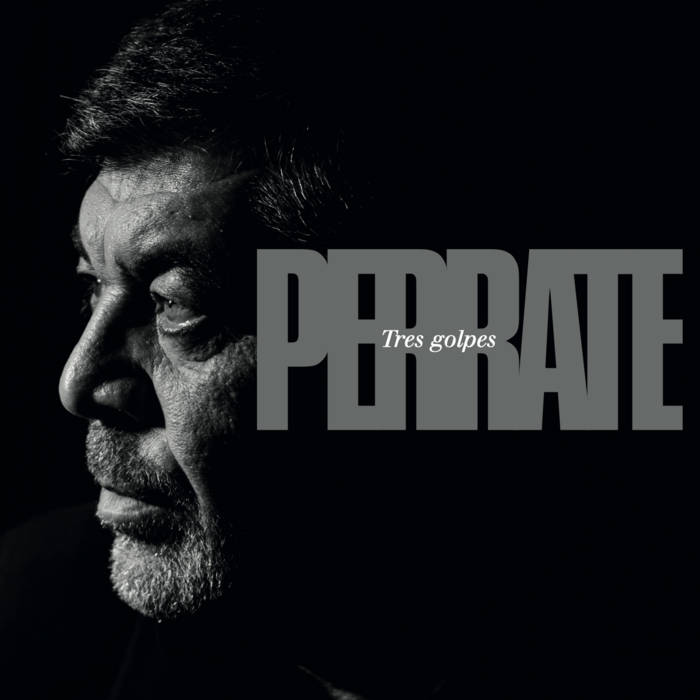
Tres golpes is PERRATE’s radical bet on the present of his surname. PERRATE conveys the original meaning of ‘pure’, which is not something that has to do with blood, tradition or lineage. ‘Pure’ has to do with form. It is always redundant to talk about hybridisation in flamenco music. The Triana soleá and seguiriyas cabales are hybrids themselves, and yet they have their own defining form. Even something without a specific form can be pure.
Tres golpes has that: three glances at the cante, tradition and form, three knocks with the knuckles on the wooden table. The original song «Tres golpes» is a street fandango by Los gaiteros de San Jacinto, a Colombian traditional folkloric group inspired by the African music brought by slaves and freedmen to the Pacific South America. To PERRATE, it also means a proclamation as, in a way, it arranges the variety of artistic approaches that this work contains.
On the one hand, Tres golpes includes cantes in their own familiar form. Rather than flamenco singing in the house, they originate at the house door, which is where they used to take place raw, unadorned. On the other hand, there is a singular approach to styles that may have been part of the origins of flamenco but disappeared with the time, for some reason. I am talking about the chacona, the jácara or the folía that Tomás does not sing with the attitude of an historicist, but imagining what would have happened with these palos if they had gone through the two centuries of metamorphosis —some call it «degeneration»— that forged flamenco. Finally, in a similar way, tonás, romances, seguiriyas and seguidillas are given a new sound, a tactile sound that can be touched, felt, weighed.
Of course, this is why Raül Refree was chosen to conduct the production. He is the one who has best materialised the radical sound of the latest flamenco. Here, with PERRATE, he has gone even further. His expertise faces now raw singing, a voice that slit opens like the old grooves of a vinyl record. Stylus voice, rather than laser voice. Analogue voice. And digital too, provided that digital has to do with the fingers. Three fingers signalling three beats that cue the music.
PERRATE likes that hypothesis about his preceding Loreto —second last name of Manuel Soto, his grandfather, the legendary ‘Manuel Torre’—, the idea that such Loreto name may well have developed from Leyton, a slave surname, which would vindicate his «black» origin. There it is, consequently, his black sound, which expands its meaning now not just because of the Black Africa but also because of the dark leather, the dark underground, the electric cellar where the sounds of the 21st century were born. Yes, because of that blackness too.
(ESP)
Con Tomás de Perrate ese atributo, el de flamencos radicales, toma su más hondo sentido. No son solamente radicales por la forma extrema de sus propuestas artísticas, además van a la raíz, conocen o son literalmente raíz. Ya saben la verdad dicha por José Bergamín: «Buscar las raíces es la forma subterránea que toma el aéreo irse por las ramas». Bergamín no está relativizando el empeño underground, más bien pone en valor lo que significan la fuga, el extravío, el perderse en los campos del significado y el significante.
Tres golpes es la apuesta radical de Perrate por el presente de su apellido. Perrate tiene el significado original de «puro», que no es algo que tenga que ver con la sangre ni con la tradición ni con el linaje. Puro tiene que ver con la forma. Hablar de hibridación en flamenco siempre es redundante. Híbridos son la soleá de Triana y las seguiriyas cabales sin dejar de tener una forma bien definida. Incluso lo informe puede ser puro.
Tres golpes tiene eso: tres miradas de los nudillos de la mano sobre el cante, la tradición y la forma. «Tres golpes» es un fandango callejero de Los gaiteros de San Jacinto, un grupo colombiano en la tradición de la música africana que llevaron los esclavos y tantos libertos de la zona del Pacífico. Para Perrate es una proclama también, algo que ordena las distintas formalizaciones que en este trabajo se alcanzan.
Tres golpes lleva, por un lado, cantes con una forma familiar propia, no tanto cantes de la casa, más bien de la puerta de la casa, que es donde a menudo se hacían así, crudos, sin adornos. Por otro lado, hay una personal aproximación a formas que pudieron haber estado en el venero del flamenco, pero que, por alguna razón, se perdieron. Me refiero a la chacona, la jácara o la folía que Tomás hace, no con la coartada historicista, sino, más bien, imaginando qué hubiera pasado con estas formas si hubiesen atravesado los dos siglos de metamorfosis -algunos lo llamaban «degeneración»- que significa el flamenco. Finalmente, y a partir de ese mismo sentido, hay formas nuevas para tonás, romances, seguiriyas y seguidillas, un nuevo sonido, táctil, algo que se puede tocar, palpar, pesar.
Y desde luego ahí entra la apuesta por Refree, el productor que mejor ha definido el sonido radical del último flamenco y que con Perrate da otra vuelta de tuerca. Su caja de herramientas se enfrenta ahora a una voz cruda, que se abre en canal como los antiguos surcos del vinilo. Es una voz más de aguja que de láser, más analógica. Y digital, sí, pero cuando lo digital viene de dedo, de tres dedos.
A Tomás de Perrate le gusta la historia de que su Loreto antecesor, el segundo apellido de Manuel Soto Loreto, o sea, del histórico Manuel Torre, sea una translocación de Leyton, apellido esclavista que vindicaría su origen «negro». Y ahí están, entonces, los sonidos negros, ahora ampliando su significado no sólo por el black de la negritud africana, también por lo oscuro del cuero y lo subterráneo, de la cueva eléctrica donde nacieron lo sonidos del siglo XXI, también por ese negro, también.